Moignes court Heritage information

Moignes Court is the oldest inhabited house in Dorset built in 1267. We know the date because a grant was given from Henry 3rd’s wife to William Le Moyne. The grant stated that he may “close his house at Ogre, county Dorset, with a good dyke and stone wall but without making crenellations”. We feel this restriction was probably due to the experience Henry had with Simon De Montfort’s rebellion where he and his followers hid behind crenellated castles and were difficult to defeat. Henry’s son, who became Edward 1st, defeated Simon De Montfort at the battle of Evesham in 1265.
The Le Moyne’s had held the land since the time of Henry 1st in exchange for sargenty of the kitchen where they would provide the king with food as he travelled via Dorset around the country. Moignes Court was probably not the principle residence of the Le Moyne family. They also held property at Shipton Moyne in Gloucestershire, and in Essex. We believe that the occupants of Moignes Court were likely to be tenants of the Le Moyne’s. The Le Moyne’s held this land until the reign of Edward 4th when their daughter married Lord John Stourton. The Stourton’s held the manor and Shipton Moyne until the reign of Mary. At that time Lord Charles Stourton was convicted of murdering his neighbours who lived near him in Wiltshire. He was hung with a silk chord due to his rank.
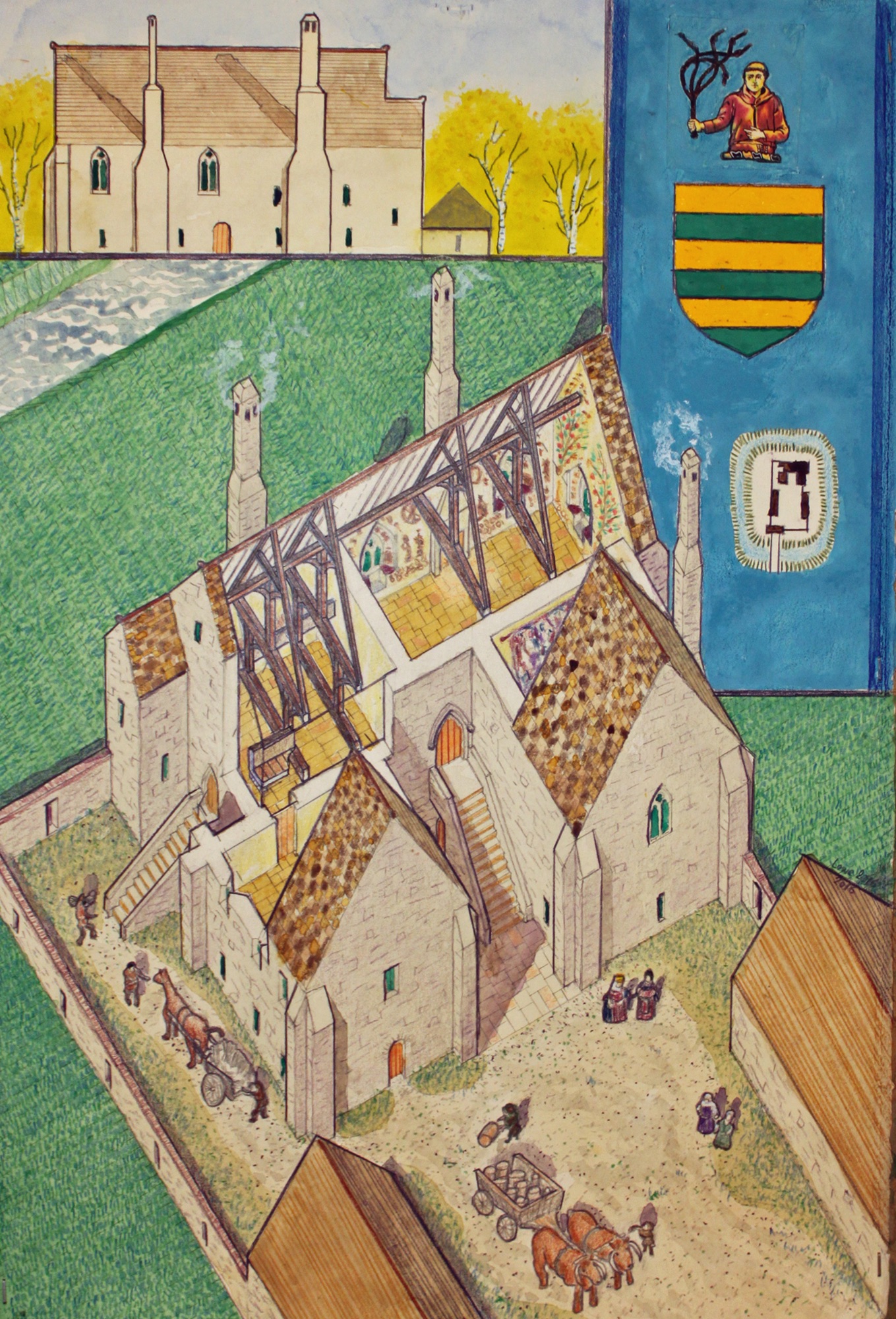
artist impression of medieval moignes court courtesy of john lowe
The estate was sold to William Wake, a Dorset man who later became the Archbishop of Canterbury. In the 1720’s Wake sold the estate to Sir Theodore Jahnsen who originally came from Holland and was a non-executive director of the South Sea company that was involved in the infamous South Sea bubble. The company had recruited him to add respectability to their board of directors. As there were no limited liability companies in those days the directors had to pay out very large compensations to the share holders. Jahnsen had to pay £200,000 which would be a huge amount in today’s money, which left him with £50,000. Most of the other directors were allowed to keep only £5000. Jahnsen’s daughter married the youngest son of the Earl of Dorchester Lionel Damer. In 1826 the Jahnsens sold the estate to the Cree family.
drawing of moignes court in 1876

Architectural Information

West Elevation
There are two cut off chimney stacks, the one on the left would have heated the first floor hall and the one on the right serviced the kitchen. The arched window in the middle was moved from the north wall and replaced the chimney. You can see the arched remains of the original front entrance which led to a central cross passage. To the right was the kitchen and above it the buttery. In the Middle Ages, a buttery was a store room for liquor, the name being derived from the Latin and French words for bottle or, to put the word into its simpler form, a butt, that is, a cask. A butler, before he became able to take charge of the ewery, pantry, cellar, and the staff, would be in charge of the buttery. To the left of the passage would have been store rooms. To the right of the kitchen chimney was a spiral staircase leading to the 1st floor. The Southern and East wings were built by George John Cree in the 1890’s. At this time the spiral staircase was replaced with a more modern staircase on the eastern side of the building, the cross passage blocked and main entrance moved into the South wing. The roof was thatched which burned off in 1890.
North Elevation
It is possible to see the faint traces of where the middle arched window used to be. Possibly the reason for moving it was to install a chimney that serviced the first floor hall. The East wing was built on what would have been the medieval solar wing where the senior members of the family had their private quarters and the rest of the family would have bedded down in the main hall.


East Elevation and court yard
The house would have originally had a U-shaped courtyard on the eastern side which contained buildings such as a brewery. The bricks for the house were manufactured in a brick kiln situated a field away to the south east of the house which went on to be a commercial enterprise providing local buildings with brick for a time. You can see the archway that would have been the entrance to the first floor hall accessed via a wooden external staircase. The ceilings of the ground and first floors were raised in the 1890’s, and you can see the evidence of this in the old entrance to the first floor hall. The arched window underneath would have been the exit of the central cross passage. Up until around 1900 the southern outbuilding was used as a coach house and stables, and the northern building for other animals and tools.
South Elrvation
The south elevation forms one of the newer parts of Moignes Court, added during the 19th century but carefully designed to sit in harmony with the much older fabric of the house. Built in local stone and using traditional proportions and detailing, the addition feels as though it has always belonged here. Facing south, this side of the house enjoys wonderful sunlight throughout the day, while the tall French windows allow light to flood into the kitchen and dining room and open directly onto the gardens. It is a lovely example of how Moignes Court has evolved over the centuries, with each generation adapting the house while respecting the character and history that came before.

Portraits of the eight Generatons
Portraits in the Court Coom
Portrait of John Cree: John fought in the Napoleonic wars and inherited from his uncle who was also called John Cree. One of the conditions of the inheritance was that John change his surname from McMahon to Cree. At the time he was living in Dublin where his father was an apothecary. John Cree senior was a free trader based in Dakar who bought Indian cloth which he exported to Europe. He mainly used the Danish owned Asiatic trading company so he could get around the monopoly of the East India company. When he retired to London he also leased a country house called Thornhill at Stalbridge. John Cree junior decided to terminate the lease on Thornhill and in 1826 purchased the Owermoigne estate which included Moignes Court.
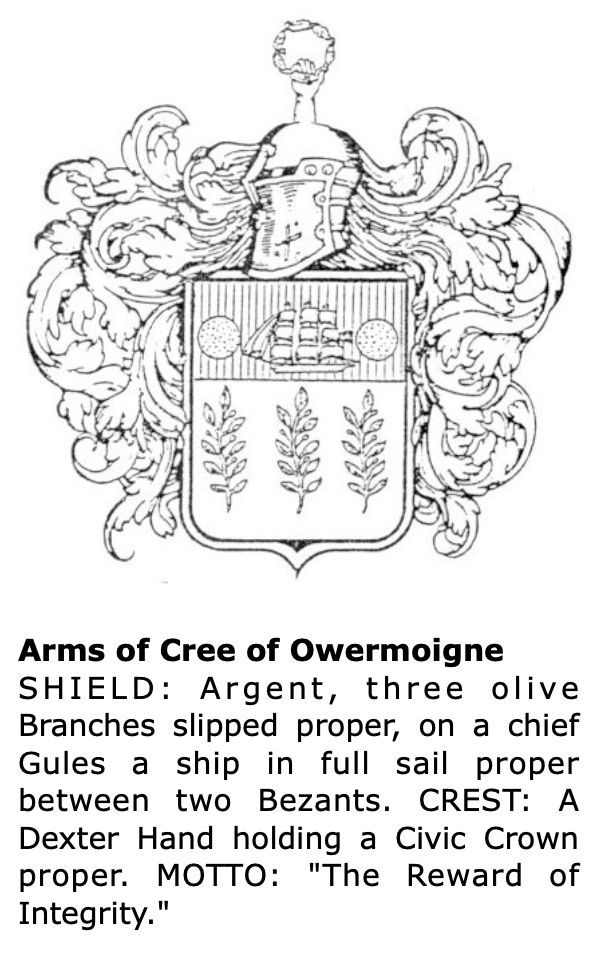
Grant of Arms to the Cree family dated 1815: Here you can see the Cree coat of arms and crest. Originally this was granted to John Cree senior in India and when John Cree junior inherited he was able to use the Cree coat of arms.
John Robert Cree (rector of owermoigne) and his brother James Cree (rector of Chaldon) both had no children but their sister Georgiana did with a rector from Devon called George stone. Their son George John Stone inherited Moignes Court from his uncle John Robert Cree. Once again, the condition of inheritance was that George change his surname to Cree. You can see a photo of the family at this time in their carriage which would have been housed in the outbuilding in Moignes Court courtyard.
George had 3 children Aubrey, Cecil, Adrian and Evelyn. Adrian died as a young man in 1916 in Ypres during WW1 and the family received a letter and medallion from the king. During WW2 the Crees had to vacate Moignes Court because it was used by the army. The family possessions were locked in the attic which was looted by soldiers and the medallion stolen and sold. Later a family bought the medallion from an antique shop and hung it above the fireplace of every house they owned. When they retired they decided to track down the family of Adrian Victor Cree as his name displayed on the medallion. The medallion was eventually given to Martin Cree and is now back in the house.
Cecil Cree inherited Moignes Court and married Dorothy Cree. They passed the house on to their son George. You can also see a portrait of his sister Cecily who is also pictured here as a girl tossing a white rose to the Prince of Wales (later Edward 7th) in 1928 while he was driving out of Max Gate having lunched with Thomas Hardye.
Ariel photo 1961: it is possible to see the original ditch around the village going through the field to the south of the house.
1920’s photo: you can see the croquet lawn installed by Dorothy Cree.
The moat:
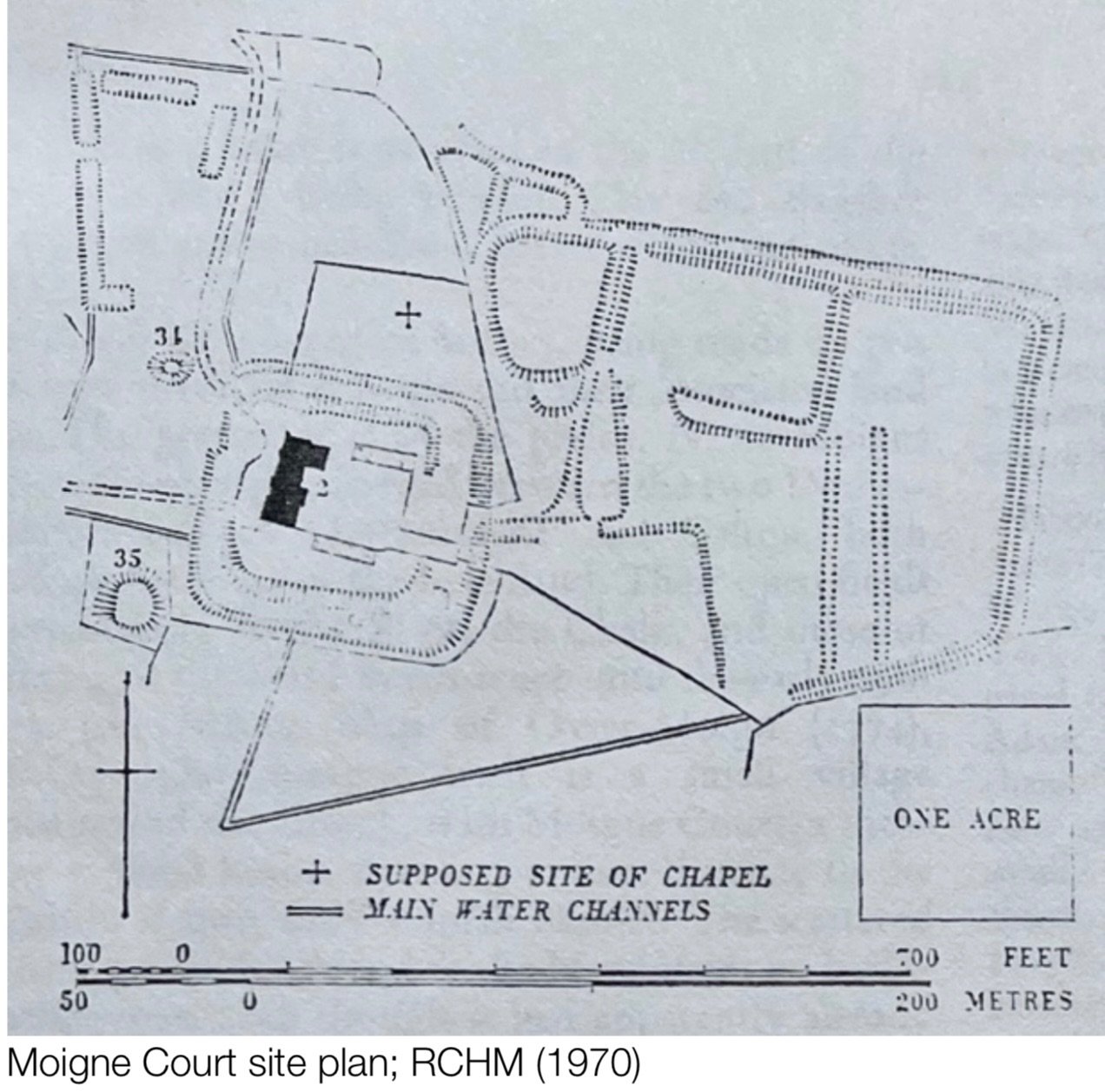
This was dug in 1267 as part of the fortifications for the house, but also drained the area with was generally very wet. Currently we have many nesting water birds every year including Mallards, Mandarin ducks and Moorhens. Originally the moat went all the way around the house, Dorothy Cree (4th generation Cree at Moignes Court) filled in the western section to create a croquet lawn. The original entrance to the house was on the bridge to the east of the house and would have had a draw bridge.
Roman / Medieval village:
Owermoigne is a compound word: Ogre was the Saxon name for the village and Moigne is a reference to the Le Moyne family. The medieval village was deserted in the 13th century when the climate became much wetter. The village was moved to the South onto free draining chalk. The oldest part of the St Michael’s Church dates back to the 14th century. The large platform was a Saxon fort and the ancient village laid out to the north. The access would have been along Castle lane (currently the first part of Moignes Court drive and then part of the farm track heading east)
The village was about 10 acres in size and surrounded by a ditch, half of the northern part still remains to this day, which would have extended all the way to the woods. You can see to the east, south along the edge of the wood and then coming back towards the house. The Saxon fort hasn’t been excavated, but the earthworks to the north were excavated in 1972 by archeologists and remains of roman as well as medieval artefacts were found. There was a long building running across the end of the field which was a barn. There was also aTudor farm house to the west and a cobbled courtyard. Martin Cree was involved in the excavations and found some shards of 11th century pottery. There was very little dressed stone remaining and we presume that this was taken to build the new village on it’s present site.
Information courtesy of Martin Cree

photo of moignes court 1960
Cree Family History
JOhn Cree the first Generation
John Cree junior is the first generation of the cree family at Moignes Court. He decided to terminate the lease on Thornhill and in 1826 purchased the Owermoigne estate which included Moignes Court.
Portrait of John Cree.: John fought in the Napoleonic wars and inherited from his uncle who was also called John Cree. One of the conditions of the inheritance was that John change his surname from McMahon to Cree. At the time he was living in Dublin where his father was an apothecary. John Cree senior was a free trader based in Dakar who bought Indian cloth which he exported to Europe. He mainly used the Danish owned Asiatic trading company so he could get around the monopoly of the East India company. When he retired to London he also leased a country house called Thornhill at Stalbridge. John Cree junior decided to terminate the lease on Thornhill and in 1826 purchased the Owermoigne estate which included Moignes Court.
Grant of Arms to the Cree family dated 1815: Here you can see the Cree coat of arms and crest. Originally this was granted to John Cree senior in India and when John Cree junior inherited he was able to use the Cree coat of arms.
The information on this page is shared from the cree surname website and used here with permission from the publisher mike spath
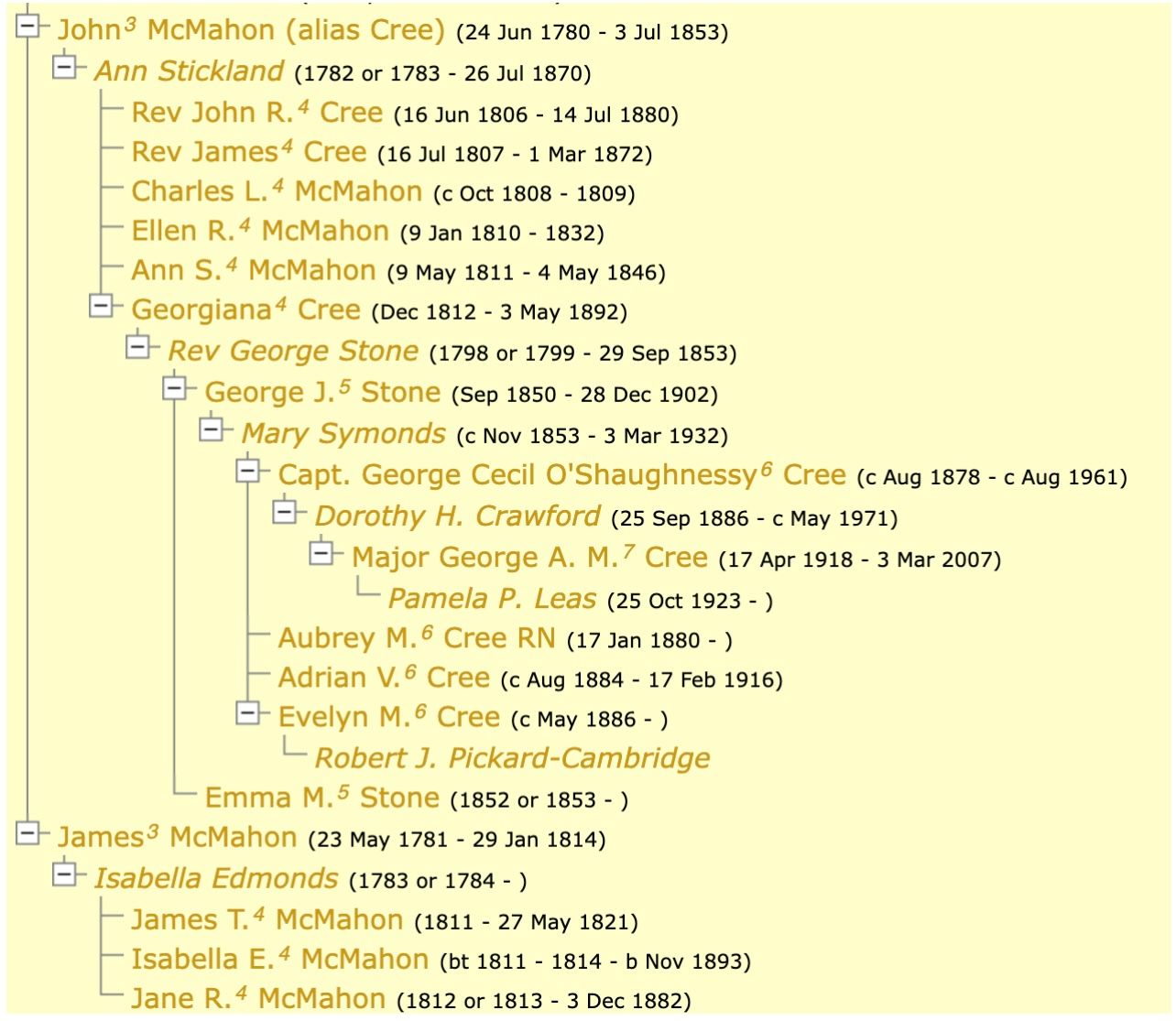
This family tree shows the lineage of 5 generations of Crees at Moignes Court from John Cree and Ann Stickland who bought Moignes Court in 1826 to George and Pamela Cree
There have been a further 3 generations of Crees living at Moignes Court: Anne and Martin Cree, Ralph and Rebecca Cree, Ocean and Solar Cree.
According to a document held by the College of Arms in London, John Cree of Ennis had a daughter Ellen Cree who married James McMahon of Ennis Co. Clare (died 1783). As far as we know their son was known as John Cree throughout his life, (although he was referred to as John MacMahon, otherwise Cree, in a document written twenty years after his death).
He made his fortune as a free merchant in the East Indies. Incidentally, although he is recorded as having died "without issue" he did in fact have two children, a son and a daughter, whose baptisms were recorded in Calcutta with the description "natural child". His only "legitimate" child died at the age of four, so his estate passed to his nephew, also John McMahon, of Thornhill in Dorset, and "by Royal Licence bearing date 1 June 1815 he [the nephew] and his issue were authorised to assume the surname of CREE only and to bear the arms of Cree pursuant to a clause in the last will and testament of his uncle John Cree abovementioned." So the nephew changed his name to Cree. He later acquired Moignes Court, also in Dorset.
Later the estate passed through a daughter to George Stone, who also had to change his name to Cree in order to inherit. Moignes Court is today occupied by his descendants who as a result of the will of the original John Cree, formerly McMahon, still bear the name Cree.
The life of John Cree has now been thoroughly researched, mainly by Trevor Cree and Mike Spathaky. His genealogy can be seen in the Cree On-line Genealogy Database on his person details page. You can also read Mike's Biography of John Cree, while a large number of transcriptions of archives relating to his life are listed in the Archives Section under the name Merchant of Dacca.
John Cree was born c 1735 in County Clare, Ireland. The date is a guess and the place uncertain. John was described as "late of Calcutta in the East Indies but then of St Mary la Bonne... and also of the County of Clare..." in his nephew's grant of arms in 1815. This was said in that document to be a recital of his own grant of 1786 but the phrase "and also of the County of Clare" does not appear in the earlier grant. County Clare is however the only suggestion we have of a place of birth.1 He was the son of James McMahon and Ellen Cree.
John Cree arrived in India before 1765. He sailed on board a ship of the East India Company and is said to have deserted on arrival in India. John married Anna Ritta Scott (married name) between 1765 and 1767. His son James Cree was born on 12 August 1774 and daughter Eleanor Cree was born on 14 December 1775 in Dacca, Bengal, India.6,7
John Cree was a free merchant (that is, not a servant of the East India Company) in 1776 in Dacca, India. John Cree was mentioned in the Ninth Report of Select Committee: "The Spirit of those Agents will be fully comprehended from a State of the Proceedings before Mr Rouse and Counsel, on the Complaint of a Mr Cree (John Cree), an English free Merchant at Dacca, who had been twice treated in the same injurious Manner by the Agents of Mr Hurst, the Commercial Chief at that Place.'
On 6 March 1786 John Cree of New Cavendish Street, London, England, joined the Whig Club. He was still recorded as a member in 1792.16
On 6 April 1786 John Cree, "late of Calcutta in the East Indies and now of the parish of St Mary le Bone [Marylebone] in the County of Middlesex, Esq." was granted arms by the Ulster King of Arms: "Argent three olive branches slipped proper on a chief gules a ship in full sail Proper between two bezants. Crest - a dexter hand holding a civic crown Proper. Motto - The Reward of Integrity." The similarity of these arms to those of various Creagh families cannot be accidental.17,18,19,20
John Cree bought Thornhill House, Stalbridge, Dorset, England, from Isaac Sage in 1787.21,22,23
Thornhill House, Stalbridge, by Mike Searle
Thornhill House was designed and built by Hogarth's son-in-law, the C18 painter Sir James Thornhill in about 1725. The house is set in acres of parkland with landscaped gardens, and is a Grade II* Listed country house.
© Copyright Mike Searle and licensed for reuse under this Creative Commons Licence
His son William Johansen Cree died on 21 March 1788 in Romford, Essex, England.14
21 June 1790 John Cree was in Spa, Belgium.24
Between 3 October 1790 and 6 November 1790 John Cree commissioned the Senate of Nice to validate a will drawn up by the Irish merchant Francesco Mac Mahon who died in Nice. John was described as "the English gentleman."25
On 16 April 1791 John Cree was involved in a fight at Major Brady's lodgings in Brussels with a Mr Macnamara over a matter concerning the honour of Mrs Cree. "Mr Cree, incensed at his appearance in the same Company with him, instantly gave him a stroke of his cane across the head, the cane flew out of Mr. Cree's hand, but he attacked his adversary so vigorously with his fists, that he shortly became his Master & obliged him to have recourse to pistols which he carried about him, and which he attempted firing at Mr. Cree, but was fortunately prevented by Major Brady and me, by wresting the pistol out of his hand. Mr O'Shee & Major Brady, separated the antagonists while I carried the pistol taken from Mr Macnamara, into a second room. The Major insisted on both remaining quiet, for which they pledged their words & honour, but Mr Mcnamara, finding Mr. Cree, off his guard, flew at him and gave him a blow of his fist on the face, which Mr. Cree returned and pummelled him across the room..."26
In July 1791 John Cree was in Spa, Belgium, as shown by a letter he wrote from there asking for a passport to be issued to a Mr Reading and his family.
No doubt John was in Belgium in readiness for the arrval in Ostend of the ship "Eliza" from Bengal of which he probably had majority ownership.27
John Cree was one of three nominees for the post of Sheriff of Dorset 12 November 1791. He was not appointed.28
In 1792 John Cree took out an insurance policy with the Sun Fire Office, as did his friend James Archdekin.29
John Cree left a will dated 16 July 1794. This will is mentioned in the later will of 20 October 1795 as being revoked by it. However a licence to John Cree's nephew John McMahon in 1815 refers to the 1795 document as a codicil dated 20 October 1795 and seems to imply that the 1794 will was the valid will.30 He and Carolina Matilda Fix were separated on 15 April 1795 in Copenhagen.31,32
John Cree made a will dated 20 October 1795 at Thornhill, Stalbridge, Dorset, England. This explicitly revoked the will dated 16 July 1794, but was not accepted as lawful for the real estate. See the will of John Cree.33,34,35
John Cree died on 19 November 1795. He died "without issue." (We know he had had a legitimate son who had died young and, earlier, two 'natural' children.)36 He was buried on 23 November 1795 in St Marylebone, Middlesex, England.36,37
His will was proved on 26 February 1796. This was the will dated 20 October 1795. We have looked closely at this will, the Chancery Court cases of Byrn v. Godfrey (1798) and Godfrey v. Davis (1801) and the Inquisition held at Dorchester in 1799 into the land and effects of John's widow Carolina Matilda, in case they would shed light on the inheritance of the Cree name and how Thornhill House came into the possession of John Cree's nephew John McMahon.
The probate of the 1795 will granted administration of all and singular the Goods Chattels and Credits of the deceased. Thus only the personal estate and not the real esatate was to be administered according to this will. This is confirmed in the case of Byrn v Godfrey which refers to his will, dated the 20th of October, 1795, but which was not executed as is by law required to pass real estates.
The Inquisition held at Dorchester in 1799 into the land and effects of John's widow Carolina Matilda reported that, the said John Cree... did duly make and publish his last Will and Testament in writing bearing date... 16th July 1794... and was duly executed and attested as by Law required for passing and devising real Estates and that the same hath been established in his Majesty's High Court of Chancery...
Although it took some detective work to discover and interpret the various documents, the result is clear. The later, 1795 will was deemed valid for John's personal estate, the Goods Chattels and Credits of the deceased, but was deemed as not executed as is by law required to pass real estates, that is, it was not a valid will for the adminstration of the land and buildings that John Cree held at his death. The test of validity was stricter for real estate than for personal estate. For the real estate the earlier will of 1794 had to be the one that operated as it had been properly signed by John Cree and two witnesses and the 1795 will had not.
The later case of Godfrey v. Davis (1801) is consistent with the above conclusion, as its conclusions were based on the assumption that the 1795 will was valid as far as John's personal estate was concerned.38,39
In 1798 "John Cree Esqr" is named as a proprietor in the parish or tything of Thornhill. Since he had died in 1795 there must be an error in compiling the original document. The estate was probably in the hands of John Cree's executors and trustees. (His namesake and nephew John McMahon/Cree was only 18 and did not start using the surname Cree until about 1815.)40
In 1815, John Cree was also known as John McMahon. This was of course 20 years after his death. College of Arms documents from 1815 are the only ones we have found that apply the name McMahon to John.41